Vendor risk teams have more visibility than ever.
They can monitor more vendors, ingest more external data, receive more alerts, and see more changes between formal assessments. That is progress. It is also exposing the next bottleneck in third-party risk management.
The hardest problem is no longer simply knowing that something changed. It is turning that change into a timely, consistent, and documented response.
A breach alert appears. A certification expires. A score moves. A new signal suggests a vendor’s security posture has changed.
The monitoring tool has done part of the job. The operating question is what happens next.
For many teams, the answer is still manual work. Someone has to interpret the signal, find the vendor record, review the business relationship, check prior assessments, decide whether the issue is relevant, identify an owner, launch the response, and preserve the record.
That is where vendor monitoring often creates more work than it removes.
Monitoring is now a necessary part of modern third-party risk management. Vendor relationships, digital dependencies, regulatory expectations, and threat activity all move too quickly for annual or periodic assessments to carry the full burden.
The problem is monitoring that stops at the alert.
The new bottleneck is response
Third-party risk is becoming more visible and more consequential. Verizon’s 2025 Data Breach Investigations Report found that third-party involvement in breaches doubled from 15% to 30%. That does not simply create a visibility problem. It creates a response-capacity problem. More vendor-related events mean more moments when teams must determine relevance, ownership, action, and documentation before the next scheduled assessment.
For years, vendor risk programs were built around point-in-time review. A vendor was assessed during onboarding, reassessed on a schedule, and escalated when something obvious changed.
That model still matters. Assessments create structure. They collect evidence. They support approvals, renewals, and risk decisions.
But they are not enough on their own.
A vendor can be breached between assessment cycles. A certification can lapse after approval. A company can be acquired. A key dependency can fail. A new disclosure can emerge long before the next scheduled review.
This is why monitoring became essential. It gives teams a way to see change between assessments.
But once the organization can see more signals, it has to decide what to do with them. Signal volume increases. Review queues grow. Teams gain more visibility into potential risk, but not necessarily more capacity to evaluate, prioritize, and resolve it.
Detection has scaled faster than response.
That is not a visibility problem. It is an operating model problem.
Monitoring is not the workflow. It is where the workflow starts.
A vendor risk signal is not self-executing.
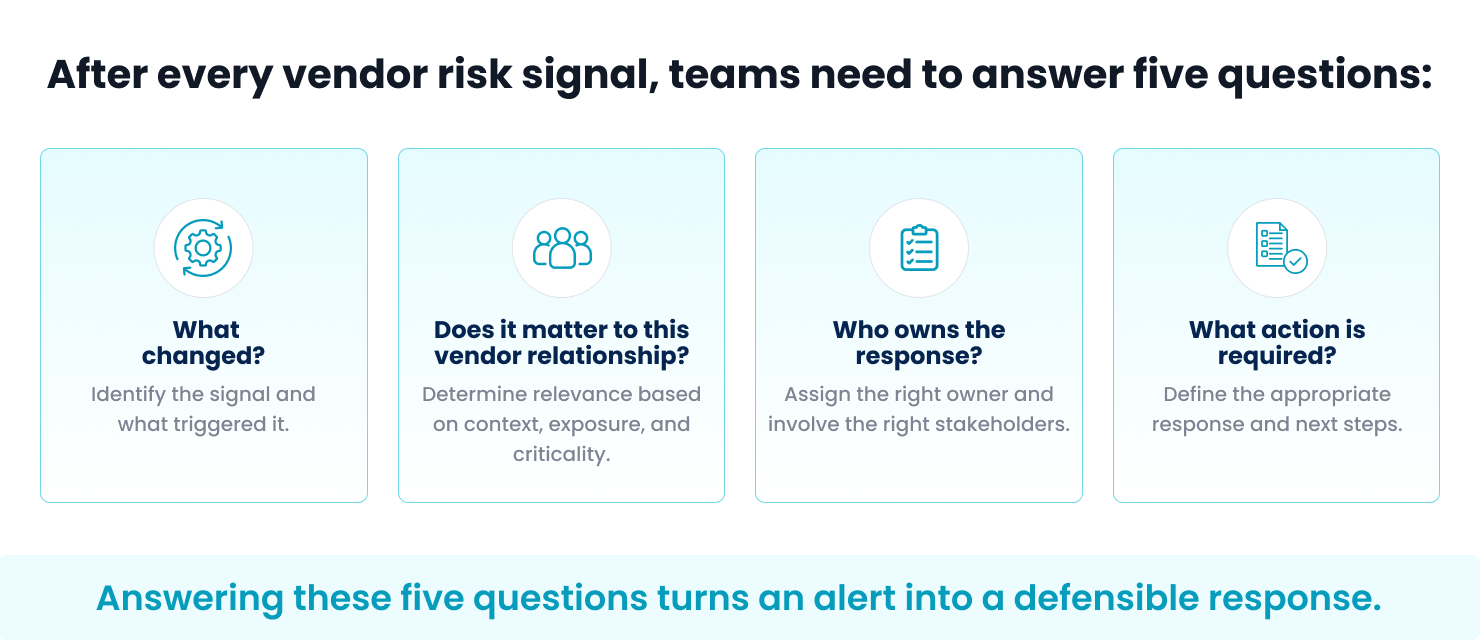
Even a credible alert leaves five management questions unresolved:
- What changed?
- Does it matter to this vendor relationship?
- Who owns the response?
- What action is required?
- Can we prove the decision later?
These are not dashboard questions. They are workflow questions.
Monitoring can tell the team that something happened. It cannot, by itself, determine whether the signal matters to the organization’s specific vendor relationship.
A breach disclosure may be material for one vendor and irrelevant for another. A certification lapse may be urgent for a critical vendor handling sensitive data and low priority for a vendor with limited access. A score change may deserve escalation in one case and simple documentation in another.
The difference is not the signal. The difference is the relationship, the exposure, the evidence, and the decision process around it.
NIST framing
NIST frames cyber supply chain risk management as a systematic process for managing exposure across the supply chain and developing response strategies, policies, processes, and procedures.
That framing matters. Effective third-party risk management is not just a sensing function. It is a response system.
When monitoring is disconnected from vendor context, every alert starts from zero. The team has to leave the monitoring environment, locate the vendor profile, reconstruct the relationship, search prior assessments, identify stakeholders, and decide what action to take.
This is how monitoring becomes another queue.
The signal-to-response gap
The signal-to-response gap is the operational distance between detection and documented disposition.
It is the gap between knowing that something changed and being able to show what the organization did about it.
In many vendor risk programs, that gap is hidden inside manual handoffs. The alert appears in one system. The vendor record lives in another. The issue is tracked in a ticketing tool. The discussion happens in email or Slack. The evidence sits in a shared drive. The final decision is captured later, if it is captured at all.
This fragmentation may not be visible in a dashboard, but it becomes visible during a board review, customer inquiry, audit, or post-incident analysis.
At that point, the organization is not only asked whether it knew about the signal. It is asked what it did.
The defensible artifact is rarely the alert itself. It is the response record.
That is why the signal-to-response gap matters. It is the difference between a monitoring program that creates awareness and a risk program that can demonstrate action.
Signal-to-response rate: the metric that matters after the alert
Many monitoring programs measure activity at the top of the funnel.
How many vendors are being monitored? How many alerts were generated? How many signals appeared this month? How many dashboards were updated?
Those metrics describe coverage and activity.
They do not show whether monitoring is reducing risk.
A better operating metric is signal-to-response rate: the percentage of relevant monitoring signals that move through review, contextual analysis, action, and documented disposition.
This metric changes the management conversation. It helps leaders understand whether monitoring is creating useful risk decisions or merely expanding the review queue.
It also helps identify where the process breaks down.
| Stage | Management question |
|---|
| Signal detected | What changed? |
| Context attached | Does it matter to this vendor relationship? |
| Triage completed | What response is appropriate? |
| Action launched | Who owns the next step? |
| Decision documented | Can we prove what happened? |
Each drop-off tells the organization something different.
A low review rate may indicate too much noise. A low action rate may indicate unclear triage criteria. A low documentation rate may indicate decisions are happening outside the system. A high volume of alerts with a low documented response rate may indicate that the program has more visibility than operating capacity.
That is why signal-to-response rate is useful.
It does not treat monitoring as a destination. It treats monitoring as a funnel into risk work.
The goal is not to maximize alerts. The goal is to increase the percentage of meaningful signals that become timely, appropriate, and defensible responses.
The five jobs of modern vendor monitoring
Modern vendor monitoring should not be evaluated only by the volume of alerts it can produce. It should be evaluated by how effectively it supports the work that follows an alert.
That requires five capabilities.
| Detect | Surface relevant vendor risk signals. | Failure mode: more alerts without more capacity. |
|---|
| Contextualize | Connect the signal to vendor profile, criticality, evidence, and history. | Failure mode: Every alert starts from zero. |
|---|
| Triage | Determine relevance, severity, and next steps. | Failure mode: Escalation is inconsistent. |
|---|
| Orchestrate | Assign ownership and launch the response. | Failure mode: Signals become manual handoffs. |
|---|
| Document | Preserve the decision record. | Failure mode: The record gets rebuilt later. |
|---|
1. Detection
The team needs to know when something relevant changes.
A vendor breach, lapsed certification, acquisition, outage, or other risk signal can materially change the organization’s exposure. Monitoring should bring those changes forward quickly enough for the team to respond while the information is still useful.
The failure mode is more alerts without more capacity.
Detection is the entry point. It is not the end state.
2. Contextualization
A signal becomes useful when it is connected to the vendor relationship.
The same external event can have very different implications depending on the vendor’s role, access, criticality, data handling, contractual commitments, and assessment history. Without that context, teams are forced into manual investigation before they can make even a basic triage decision.
The failure mode is every alert starting from zero.
A mature monitoring model should connect the signal to the vendor profile, prior assessment results, available documents, risk details, relationship ownership, and any open issues or known exceptions.
Instead of asking, “What is this alert?” the team can ask, “What does this alert mean for this vendor relationship?”
3. Triage
Not every signal requires the same response.
Some signals should be escalated immediately. Some require a targeted follow-up. Some should be reviewed and documented with no further action. Some may not apply to the organization’s relationship with the vendor at all.
The failure mode is unclear escalation.
A mature monitoring process needs a consistent way to determine relevance, severity, and next steps. Triage is the point where monitoring becomes risk management. It turns the question from “What changed?” into “What should we do about it?”
4. Response orchestration
Once a signal has been reviewed and triaged, the work has to move.
The appropriate response might be to update a vendor status, create an issue, launch a targeted assessment, request new evidence, escalate to leadership, notify a business owner, or document that no further action is needed.
The failure mode is manual handoff.
The alert becomes a task. The task becomes a message. The message becomes a meeting. The meeting becomes a spreadsheet. The spreadsheet becomes a record someone has to reconstruct later.
A more mature model connects the signal to the response path directly.
5. Decision documentation
The final capability is documentation.
This is often treated as an administrative step, but it is one of the most important parts of the process. In a board discussion, audit, customer review, or post-incident analysis, the organization needs to demonstrate more than awareness.
It needs to demonstrate judgment.
What was reviewed? Who reviewed it? What action was taken? What evidence supported the decision? When did the decision occur?
The failure mode is the record getting rebuilt after the fact.
An alert can show that the organization had visibility. A decision record shows that the organization acted.
The alert is not the receipt. The response is.
Scores help teams see change. Workflows help teams respond.
Scores, ratings, posture signals, and intelligence feeds can all be useful inputs. They help teams identify movement across a vendor portfolio and detect changes that may otherwise go unnoticed.
But they do not complete the risk process.
A score change does not assign ownership. A posture signal does not explain the vendor relationship. A dashboard update does not launch a reassessment. An alert does not document the decision.
This is not an argument against scores or signals. It is an argument for putting them in the right operating context.
External signals are most valuable when they help the team make better decisions faster. That requires workflow, evidence, ownership, and documentation around the signal.
The strategic question is not which tool sees the most change.
The more important question is how many of those changes become reviewed, actioned, and documented in a way the organization can stand behind.
| Alert-only monitoring | Response-connected monitoring |
|---|
| Signal appears in dashboard | Signal appears with vendor context |
| Team manually investigates | Context travels with the alert |
| Owner assigned outside the system | Owner and action path are clear |
| Response tracked in messages or spreadsheets | Issue or assessment launches from workflow |
| Record rebuilt later | Decision record preserved as work happens |
What vendor risk leaders should ask next
For CISOs and risk leaders, the next step is to evaluate monitoring as part of the broader vendor risk operating model, not as a standalone dashboard.
Three questions matter most:
1. Are monitoring signals reviewed in the same place as vendor context?
Teams should not have to reconstruct the relationship every time an alert appears. Criticality, access, assessment history, documents, known issues, and business ownership should be close to the signal.
2. Does every relevant signal have a defined disposition path?
Not every signal needs remediation, but every relevant signal should have a clear outcome: dismissed with rationale, escalated, assigned, reassessed, remediated, or accepted.
3. Can the team prove what was reviewed, decided, and done?
Decision records should be captured as part of the workflow, not rebuilt later. If documentation depends on memory, inbox history, or manual reconstruction, the program is taking on avoidable risk.
The better operating-review question is not only: how many alerts did we receive?
It is: how many relevant signals became documented response?
That question is harder. It is also more useful.
Work the response
Vendor monitoring should live where vendor risk work already happens.
When signals sit in a disconnected dashboard, teams are forced to translate awareness into action manually. They have to find the vendor profile, review the relationship, check prior evidence, assign ownership, launch the right next step, and preserve the decision record somewhere else.
That is the model that creates work.
The more mature model connects monitoring to the vendor risk workflow.
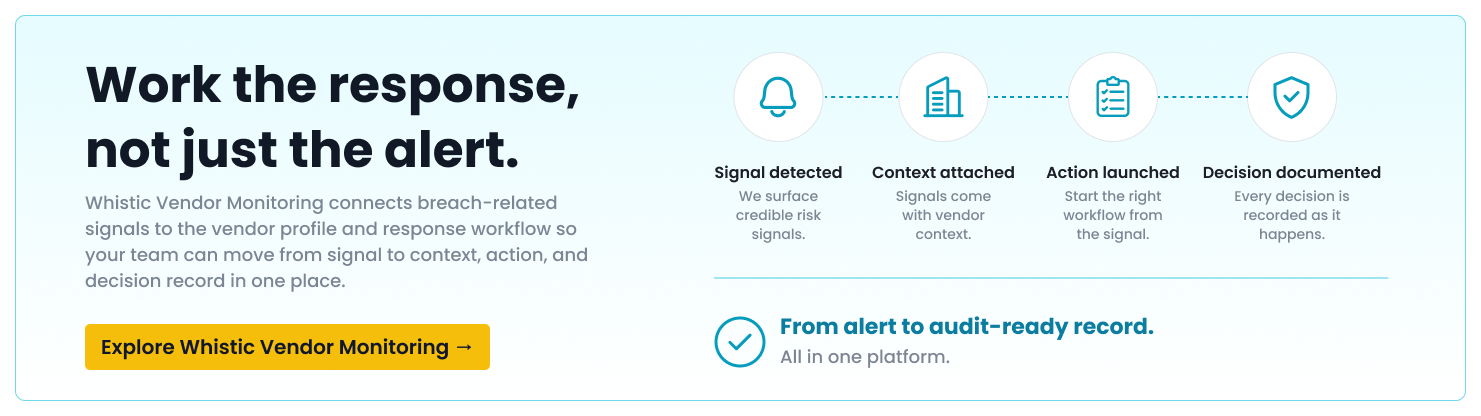
Whistic Vendor Monitoring is built around that principle. Breach-related signals are connected to the vendor profile, where teams can review context and move into response from the same place they manage vendor risk. From a single alert, teams can update status, create an issue, or launch a targeted assessment without leaving the platform.
That is the difference between monitoring as a dashboard and monitoring as part of risk operations.
The value is not simply that the organization sees a signal.
The value is that the team can work the response.
The next standard for vendor monitoring
Vendor monitoring has become table stakes. Most organizations now recognize that third-party risk changes between assessments and that teams need better visibility into those changes.
The next standard is response conversion.
Not just whether the organization can detect more signals. Whether it can turn the right signals into timely, consistent, and documented response.
That is where risk is actually reduced.
Not at the moment the dashboard updates.
At the moment the team understands the signal, determines what it means, takes the appropriate action, and preserves the record.
A signal is not the outcome.
The response is.