Why TPRM is harder in software and technology
You are not just managing vendor risk. You are running a security program that has to scale with engineering velocity, answer hundreds of customer security questionnaires every quarter, and govern an AI vendor stack that did not exist eighteen months ago.

30% of breaches now involve a third party, doubled from 15% YoY (Verizon DBIR 2025). MOVEit, Snowflake, CrowdStrike, CDK. Every named incident cascaded into thousands of downstream customers.

Every sprint adds a new SaaS, AI API, or cloud service. Security finds out after the fact. Subprocessors compound silently until a breach forces an audit.

Every LLM API, embedding model, and agent platform is a new third party with training-data questions. Every customer wants to know how you govern AI.

The average enterprise security review takes 3.1 weeks (Conveyor 2024). 52% of sales teams report security review causes deal delays. Paid by your security team, your SEs, and your forecast.
Built for the teams behind security reviews and vendor decisions
Software companies have a different buying committee than other verticals. Trust and Security titles own the customer-facing security posture. GRC fields the questionnaires. Sales and CS leadership measure the deal-velocity impact. Whistic supports all four.
You sit between the CEO, the board, and an aggressive customer base. You carry audit responsibility for the program and revenue responsibility for review velocity. Whistic gives you defensible AI assessment, a dual-sided audit trail, and board-reportable metrics on both sides.
You own the operational reality of TPRM and customer security review. The team is at capacity. Whistic compresses time per assessment, kills the inbound questionnaire queue with a Trust Center, and integrates natively with Jira, Slack, and your existing stack.
You field hundreds of customer questionnaires every quarter. You also own SOC 2, ISO 27001, ISO 42001, and the long tail of customer-specific frameworks. Whistic ships pre-built question libraries and an AI assistant that maps your evidence to new asks in minutes.
You feel security review drag every quarter end. Deals slip on the security checklist. Whistic compresses the security-review stage from weeks to days. Salesforce integration makes review a tracked sales-cycle stage, not a black box.
Every workflow your program depends on, in one platform
Software companies do not need three products. They need one platform that runs Trust Center publishing, vendor assessment, breach monitoring, and the Trust Center Exchange on one data model, with AI doing the heavy lifting on both sides.
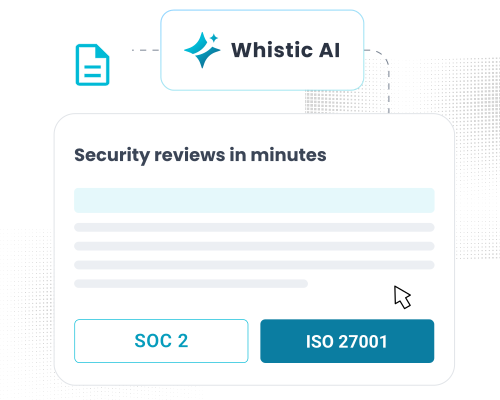
Respond to customer security reviews in minutes, not weeks
Every enterprise deal has a security review. Whistic Trust Center publishes your SOC 2, ISO 27001, ISO 42001, pen test, AI governance, and subprocessor list once, so prospects self-serve before the questionnaire arrives. When custom questionnaires do land, Whistic AI answers them from your published evidence.
- Centralize SOC 2 Type II, ISO 27001⁄27018, ISO 42001, pen test, AI governance, and subprocessor list in one profile
- Share via direct link, embed on your website, or publish to the Trust Center Exchange
- Track profile views to know which prospects are in evaluation and surface the signal inside Salesforce
- Whistic AI auto-fills custom SIG, CAIQ, and customer-specific questionnaires from your published evidence with source citations
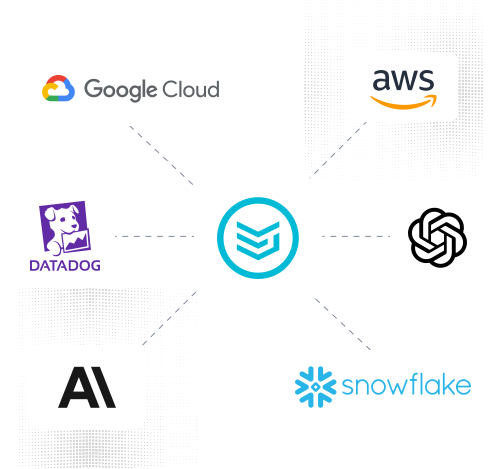
Assess thousands of vendors without sending a questionnaire
The Trust Center Exchange is Whistic’s dual-sided network of 12,000+ pre-published vendor profiles, including most major cloud, AI, infrastructure, and developer-tools vendors a modern software company runs on. Reserve full assessments for critical vendors; the rest become zero-touch.
- Pre-validated profiles for the cloud and AI vendors your engineering team adds every sprint, including Anthropic, OpenAI, AWS, and thousands more
- Filter by SOC 2, ISO 27001, ISO 42001, HIPAA, FedRAMP, or any framework that matters for your customer base
- Subprocessor and fourth-party surfacing from SOC 2 and ISO evidence, tracked over time
- Network effect: every Whistic customer is also a Whistic Profile, so the Exchange compounds with every customer
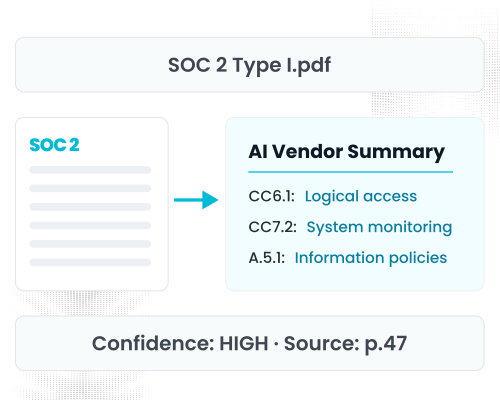
Cut vendor assessment time from weeks to hours
Whistic Assessment AI reads SOC 2 Type II reports, ISO 27001 evidence, model cards, AI governance documentation, and policy stacks. It maps evidence to your control library, surfaces contradictions, and ships every answer with a confidence score and a citation back to the source document.
- Pre-built question sets for SOC 2, ISO 27001⁄27018, ISO 42001, NIST CSF, NIST AI RMF, SIG, SIG Lite, CAIQ, CIS Controls
- Whistic AI achieves approximately 96% accuracy sourcing control-specific answers from vendor documentation
- Every output is defensible to a customer, an auditor, or a board: confidence score (High, Medium, Low) plus source citation pointing to the exact page
- Runs on Anthropic models in dedicated AWS Bedrock instances; customer data is not used for training; ISO 42001 certified
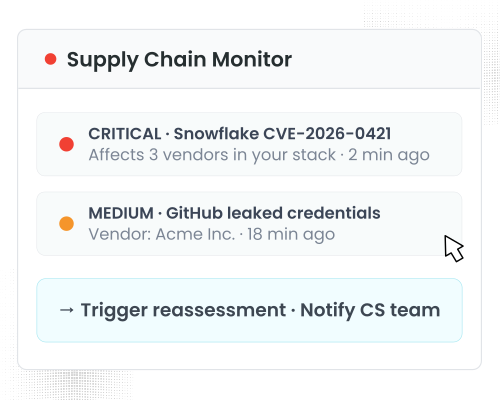
Know which of your vendors is in the blast radius before the news does
When MOVEit, Snowflake, CrowdStrike, or the next supply chain incident drops, Whistic tells you which of your vendors is exposed first. Continuous monitoring across public web, dark web, vulnerability disclosures, and SEC filings, with auto-generated response playbooks built into the workflow.
- Real-time breach alerts with severity, scope, threat actors, and supporting evidence
- Subprocessor exposure: when a vendor of your vendor is breached, Whistic surfaces your indirect exposure first
- Monitoring alerts let users launch a reassessment in Whistic Assess with one click, with a full audit trail timestamped and exportable
Built for the frameworks your customers, auditors, and regulators expect
Whistic question libraries map directly to the security and AI frameworks software companies live in, so evidence gathering satisfies multiple customer asks at once, and a new customer cert is days of work, not a quarter.

SOC 2 Type II · Service Organization Controls
ISO 27001 / 27018 · Information security management
ISO 42001 · AI Management Systems (we are certified)
NIST AI RMF · AI Risk Management Framework
EU AI Act · Transparency, watermarking, high-risk
NIST CSF / 800-53 · Cybersecurity Framework
FedRAMP / StateRAMP · US federal and state cloud authorization
SIG / SIG Lite / CAIQ · Shared Assessments and CSA standards
DORA / PCI DSS / HIPAA · Vertical and regional certifications
Results software and technology teams have actually seen
AI accuracy sourcing control-specific answers from vendor security documentation, with full source citations and confidence scoring on every output.
Reduction in time per vendor assessment in comparably regulated programs. For a SaaS company assessing 300 vendors a year, roughly 2,400 to 3,600 analyst hours reclaimed.
Pre-published vendor profiles in the Trust Center Exchange. Most major cloud, AI, SaaS, and developer-tools vendors a modern software company runs on.
Of breaches now involve a third party, doubled from 15% the prior year. Software supply chain is the dominant breach vector for the first time in Verizon DBIR history.
Industry-average enterprise security review duration. 52% of sales teams report security review causes deal delays (Conveyor 2024 State of Security Review).
Of Whistic customers actively use AI features. AI assessment is the operating standard for our base, not the early-adopter signal.
Trusted by software and technology teams
Frequently asked questions
Platform and fit
Whistic is the AI-first third-party risk management platform built for software and technology companies that are both buyers of vendors and sellers of trust. From AI-powered vendor assessment and Trust Center publishing to continuous supply chain breach monitoring and customer-facing security profile sharing, Whistic combines a Trust Center Exchange of 12,000+ pre-published vendor profiles, evidence-based AI assessment, and native breach monitoring in a single system.
SafeBase plus Drata is two products from two companies stitched together after Drata's February 11, 2025 $250M acquisition. SafeBase handles inbound Trust Center; Drata handles compliance automation; TPRM is a thin module. Whistic is the only platform where one workflow, one data model, and one audit trail run both the buyer-side TPRM and the seller-side Trust Center. The dual-sided architecture is the product, not a bundle. Whistic customers consolidate SafeBase, Drata's compliance module, and their buyer-side TPRM into one platform.
Conveyor is a sales-cycle acceleration tool. Their AI agents Sue and Phil handle inbound security questionnaires and RFPs. Conveyor has no buyer-side vendor risk workflow, no AI vendor assessment of your inbound stack, no continuous breach monitoring, and no integrated GRC capability. Whistic Trust Center covers both directions of every TPRM relationship: publish your posture and assess your AI, cloud, and SaaS vendors on the same data model.
Vanta is a compliance automation platform with TPRM as a side module. Excellent at getting you SOC 2 certified, not purpose-built for ongoing TPRM or a Trust Center that closes enterprise deals. Vanta's AI is compliance-checklist style, not evidence-based with citations. Most growth-stage tech companies run Vanta for compliance and Whistic for TPRM plus Trust Center side by side.
Whistic is a general TPRM platform with deep software and technology vertical relevance. Pre-built question libraries for SOC 2, ISO 27001, ISO 42001, NIST AI RMF, EU AI Act, SIG, SIG Lite, CAIQ. Whistic offers native integrations with Salesforce, Jira, Slack, ServiceNow, Microsoft Teams, Snowflake. Customer segments include B2B SaaS (pre-IPO through public), cloud and infrastructure platforms, AI-native vendors, cybersecurity companies, and vertical SaaS selling into fintech, healthtech, and govtech.
AI and accuracy
Yes. Whistic helps companies assess AI vendors against ISO 42001-aligned AI management system requirements by centralizing questionnaires, documentation, evidence review, and vendor risk workflows.
Yes. Whistic can support AI vendor assessments related to NIST AI RMF, EU AI Act readiness, AI transparency, data governance, privacy, security, subprocessors, and responsible AI practices.
Approximately 96% accuracy sourcing control-specific answers from vendor security documentation. Every answer ships with a confidence score (High, Medium, Low) and a source citation pointing to the exact page of the source document. Defensible to a customer, an auditor, or a board.
Whistic is a third-party risk management platform that helps companies assess vendor security, privacy, compliance, and AI-related risk. For AI vendors, Whistic helps teams collect evidence, review documentation, and manage AI governance assessments in a centralized workflow.
Whistic offers AI-assisted capabilities that can help reviewers summarize vendor documentation, identify relevant evidence, and accelerate vendor assessment workflows. Human reviewers remain responsible for final risk decisions.
No. Whistic AI is designed to assist vendor risk reviewers, not replace them. It helps teams work faster by surfacing relevant information from vendor documentation, while humans validate the evidence and make final decisions.
Whistic is designed for enterprise vendor risk management workflows where security, privacy, and compliance are important. Specific AI architecture, data handling, and model usage details should be reviewed through Whistic’s official security documentation or under NDA.
Regulatory and compliance
EU AI Act deadlines vary by use case and risk level. For software companies, the most important dates depend on whether the product is a general-purpose AI system, a high-risk AI system, or uses AI in a regulated customer workflow.
Whistic helps teams assess AI vendors against EU AI Act-related requirements, including transparency, governance, documentation, data usage, security, and third-party risk controls.
Yes. Whistic helps software companies manage FedRAMP, StateRAMP, and government customer security reviews by centralizing questionnaires, evidence, certifications, and security documentation.
Teams can reuse approved evidence across customer requests, reduce duplicate work, and support security reviews for federal, state, and regulated buyers.
Whistic helps teams assess fourth-party and subprocessor risk by collecting vendor disclosures, tracking key subprocessors, and reviewing related security and compliance evidence.
Customers can use Whistic to understand which third parties support a vendor’s services, evaluate indirect risk, and keep subprocessor information organized as part of the vendor risk management process.
Yes. Whistic can help software companies support DORA-related third-party risk reviews by organizing security documentation, vendor evidence, ICT risk information, and customer-facing compliance materials.
For companies selling into EU financial services, Whistic helps reduce repetitive security reviews and makes it easier to respond to customer due diligence requests tied to operational resilience and ICT third-party risk.
Operations and scale
Most teams can launch a TPRM program on Whistic faster than with traditional GRC platforms because Whistic is built for vendor assessment, evidence reuse, and customer-facing trust workflows.
Implementation timing depends on program complexity, integrations, frameworks, and internal review processes. Whistic helps teams start with core questionnaires, vendor profiles, Trust Centers, and repeatable workflows, then expand over time.
Yes. Whistic integrates with common security, risk, and revenue tools so teams can manage vendor risk and trust workflows without replacing their existing systems.
Whistic can support workflows across tools such as Salesforce, Jira, Slack, Microsoft Teams, ServiceNow, Snowflake, Workday, Coupa, and SSO providers. API access is also available for teams that need custom workflows.
Whistic helps software companies scale security reviews by reducing repetitive questionnaires and making approved security evidence easier to share.
With Whistic Trust Center, customers can self-serve security documentation from a published profile. With Whistic’s assessment workflows and AI-assisted review capabilities, teams can respond to vendor and customer security reviews faster while keeping humans in control of final approvals.
Pricing
Yes. Whistic offers options for growing software companies that need to share security documentation, respond to customer reviews, and build trust without hiring a large security team.
Many teams start with Whistic Trust Center to publish approved security, compliance, AI governance, and policy information in one place, then expand into broader TPRM workflows as their program grows.
Whistic is used by B2B SaaS, cloud, infrastructure, AI-native, developer tools, cybersecurity, and vertical software companies that need to manage security reviews and vendor risk at scale.
Public customer examples and case studies are available on Whistic’s website, including how technology companies use Whistic to share security documentation, reduce questionnaire volume, and build buyer trust.
Whistic pricing depends on the size of your vendor program, Trust Center needs, workflows, integrations, and overall scope.
Software companies can start with customer-facing trust workflows and expand into full third-party risk management over time. For current pricing, teams should contact Whistic for a quote based on their program requirements.
Getting started is easy
Launch your first AI-assisted vendor assessment or Trust Center workflow in days, not months. Whistic works with the security, compliance, and revenue tools your team already uses, so you can start quickly without replacing your existing stack.

Schedule a live demo to see how Whistic fits your security review process, Trust Center goals, vendor assessment workflow, and customer requirements.

Add your existing security and compliance documentation, such as SOC 2 reports, ISO certifications, AI governance materials, policies, and vendor inventory.

Publish your Trust Center, launch your first AI-assisted assessment, and help your team respond to customer security questionnaires faster.
Kill the questionnaire. Close the deal.
Certifications and Security Partnerships


