Skip to content

Introducing Automation Orchestrator

Introducing Automation Orchestrator:

AI made the tasks faster. Now agents run the workflow.

Four AI agents coordinate the vendor assessment from trigger to executive summary. Your team owns the risk decision.


Today, Automation Orchestrator is generally available in Whistic.

Whistic Assess already uses AI to read and summarize SOC 2 reports, map evidence to a framework, and cite the source behind every finding. But faster analysis never made the assessment automatic. Someone still had to notice the review was due, gather the evidence, trigger the analysis, and move the work from one step to the next.

Automation Orchestrator changes that. Four AI agents, Initiator, Collector, Analyst, and Reporter, now coordinate the assessment from trigger to executive summary. Your team reviews the findings and owns the risk decision.

It's included today for Whistic Assess customers with Whistic AI enabled. No separate purchase or add-on.

Here's what changed, what each agent does, and where this goes next.

Launch an interactive demo
 

The handoffs were still manual

A manual vendor assessment takes 12-15 hours. Roughly 90% of legacy third-party risk management effort goes to administration rather than risk mitigation. Much of that work is familiar: chasing sources, checking status, rebuilding summaries, and keeping the assessment moving.

Roughly 90% of legacy third-party risk management effort goes to administration rather than risk mitigation.

Walk through what happens when an assessment comes due. Someone notices. Someone opens the record, gathers the evidence, and checks whether it is ready. Someone launches the analysis, waits for it, builds the summary, and carries it to the decision point. Too much analyst time goes to getting to the decision instead of making and acting on it.

AI accelerated several of those tasks years ago. The person was still operating the workflow. We have written before about the handoff tax in risk operations: even when individual tasks are fast, every manual transition adds time, context rebuilding, and another opportunity for the work to stall.

Meanwhile, vendors ship AI features and add subprocessors between review cycles, and the evidence behind an approval starts aging the day it is collected. When every assessment costs significant analyst effort, teams assess less often and less broadly than the risk deserves. Risk teams need an operating model that executes more of the routine work without scaling headcount at the same rate.
 

What changed today

Automation Orchestrator is a unified hub for configuring, coordinating, and monitoring AI agents across Whistic. Agents own defined phases of work. They start when configured conditions are met, hand the work to the next phase, and pause to bring in a person when judgment or intervention is needed.

The lifecycle stays familiar: initiation, evidence collection, analysis, summary, human judgment. What changes is who performs the repeatable work between the decision points. You get the benefit without reinventing your risk program.
 

Meet the four agents

Each agent is named for the job it does, and each owns one phase of the assessment flow your team already runs in Whistic.

Initiator starts vendor assessments automatically for the vendors that you choose. You set the cadence (3, 6, 12, 18, or 24 months) and the criteria: criticality, inherent risk, business unit, and more. It covers vendors however they entered Whistic, whether through your intake form, an integration, or the API, and it evaluates new vendors against your criteria as they arrive. If someone starts an assessment manually, Initiator recognizes the conflict and reschedules the next automated assessment to help avoid duplicates. Before you enable it, it shows you exactly which vendors it will assess and when.

Collector takes the most tedious phase: source gathering. Trust Center Capture runs automatically at assessment start, finds the vendor's Trust Center, parses it, and pulls the public documents into the assessment. Collector adds existing vendor documents inside the age threshold you set, along with web sources. It can request specific questionnaires or documents, a CAIQ Lite or a SOC 2 Type 2 for example, from the vendor's contacts with a due date, and cancel unreturned requests after that date so the workflow keeps moving. If no Trust Center URL or usable sources turn up, you can have it pause and notify a person.

Analyst runs the configured Whistic AI review on the collected evidence against the framework you choose, with web sources included if you turn them on. Every finding is marked compliant, non-compliant, or unknown, with a confidence score, the evidence source, and the reasoning behind it. You can set quality gates, a minimum compliance score or a maximum number of unknowns, and Analyst pauses for human review when output falls below your bar.

Reporter compiles the Analyst's findings into an executive summary and notifies the team that the assessment is ready for human review and completion.


Full AutoAssess, defined

Full AutoAssess is all four agents operating together as one coordinated workflow. When your configured conditions are met, the assessment moves from trigger through evidence collection, AI analysis, and executive summary generation with zero routine touchpoints between phases.

Full AutoAssess does not approve vendors automatically. A person reviews the result, interprets the business and risk context, makes the risk decision, and closes the assessment. That boundary is deliberate. Agents assemble the case. People own the decision.
 

Start with one agent or all four

You do not need to hand the entire workflow to four agents on day one. Each agent turns on independently. Enable Collector and keep the review manual. Let the Initiator handle cadence while you run everything else. Or enable all four as Full AutoAssess.

Wherever you land, you keep control of the seams. Set pause points at any step where you want a person to look before the work moves forward. Step into a running assessment, finish a step yourself, and the next agent picks up automatically. In our launch webinar poll, 40% of respondents said they were engaging with automation one step at a time, the largest group in the poll. Orchestrator is built for exactly that.
 

Every agent action is inspectable

Each agent has an activity log showing completed, scheduled, and canceled actions per vendor, with search and filters, and each enabled agent shows who turned it on and when. Notification settings determine who receives agent activity through in-app and email notifications, on the delivery schedule you set.

Whistic AI findings show the evidence, confidence, and reasoning behind the output. Automation should reduce manual work without turning the process into a black box.
 

Built on Whistic AI already in production

Automation Orchestrator builds on Whistic AI capabilities already running inside Whistic Assess:

  • Whistic AI has been in production in Assess for 2+ years.
  • 96% accuracy for Whistic AI in Assess, with confidence scores and source citations.
  • 12-15 hours of analyst time per assessment reduced to 1-3 hours at one Fortune 200 financial services customer.
  • Assessment turnaround cut from 8 weeks to 1 week at that customer.
  • $450K+ in documented annual labor savings at that customer.

Those results were achieved with Whistic AI helping teams perform the assessment while people still operated the workflow around it. Orchestrator now automates the handoffs between those phases.
 

What this means for your program

Time savings. Significant reduction in time is the most immediate benefit. 

Less coordination work. Risk professionals spend less time chasing sources, checking status, remembering reassessment dates, and rebuilding summaries.

Greater coverage. A finite team can apply a configured process across more of the vendor population without increasing manual coordination at the same rate.

More consistent execution. Defined workflows reduce variation in how routine steps are performed.

Faster time to decision-ready output. Automating the handoffs reduces the delays between phases.

Optimized process.  Security teams are able to shift resources to other pursuits such as risk mitigation or similar as an item on this list.

And the human hours that come back get redirected where they matter most; clearing backlogged, high-priority security projects and focusing on the questions that actually change the decision: 

  • Is the evidence sufficient?
  • Does the exception require a compensating control?
  • Is the residual risk acceptable?

More coverage, fewer dropped handoffs, and human judgment applied where it changes the result: that is the credible path to better risk outcomes.
 

The roadmap: now, next, later

Generally available today:  the Agent Hub with Initiator, Collector, Analyst, and Reporter, Full AutoAssess, per-agent configuration and activity logs, pause points, manual intervention, and automatic handoff to the next agent, and executive summary notification when an assessment is ready for review.

Next on the roadmap: automated reminders and expanded follow-up logic for vendor source requests, vendor segments so different groups get different automation rules, agent metrics and reporting inside the hub, and automated approver requests.

Later, as roadmap direction: compliance-grade audit reporting, predictive risk scoring built on assessment patterns, two-way integrations with GRC platforms, and agentic reassessments that surface exactly what changed with a vendor since the previous assessment.
 

The first workflow, and the larger strategy

The Orchestrator is built as a home for agentic work across Whistic, and assessments are the first workflow it runs. Roadmap direction extends the agent hub beyond assessments into areas such as vendor intake and issue management.

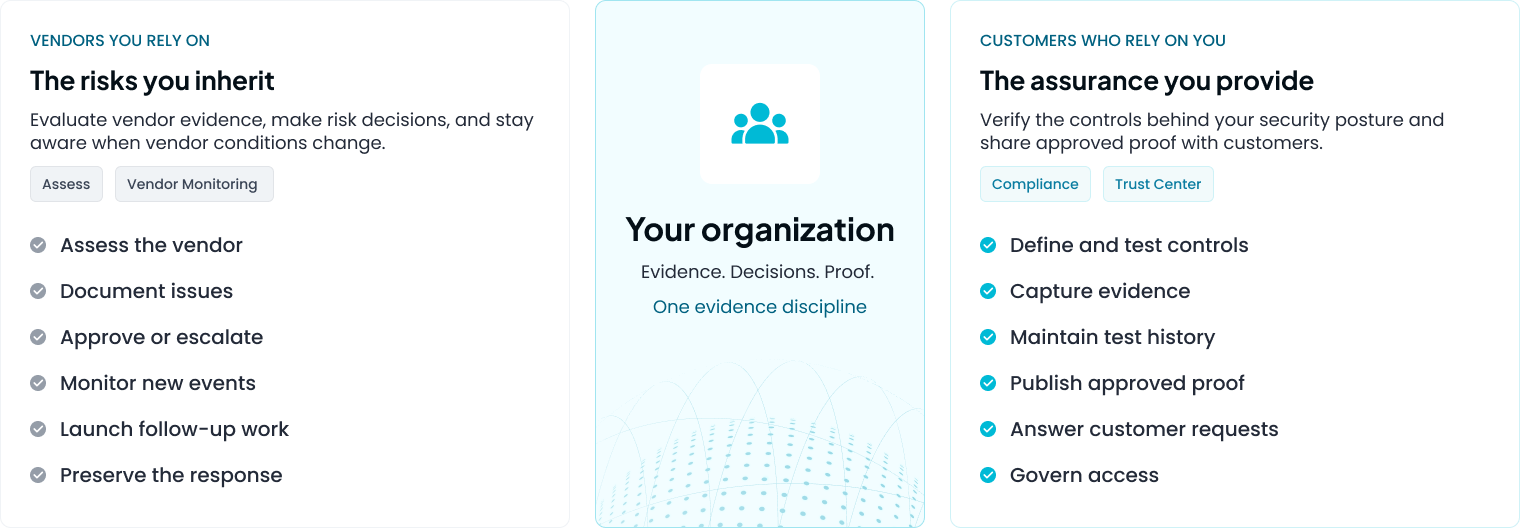
Whistic already connects assessments, monitoring, internal control testing, and posture sharing in one platform. The more of that lifecycle that shares context, evidence, and workflow, the more useful agentic coordination becomes. That is the Agentic Risk Operations Platform in product form: software executing defined risk operations and bringing people in for the decisions that require judgment and accountability.
Early access customers have been providing feedback to our Product and Development teams.
 

How to turn it on

If you're a Whistic Assess customer with Whistic AI enabled, Automation Orchestrator is available in your account today at no additional cost. An Admin can follow the online setup guide that details how to configure the agents using default settings or tune the cadence, criteria, sources, and thresholds for your program. Your CSM can help you pick the right first agent or a good initial vendor selection.

New to Whistic? Request a demo to see an automated assessment run from trigger to executive summary.

If you're at the ISACA + IIA GRC Conference in San Diego this week, August 17-19, 2026, stop by to see Automation Orchestrator live. You can also watch the on-demand launch webinar, where our product team runs all four agents through a full assessment, start to finish.
 

Frequently asked questions

What is Whistic Automation Orchestrator?

Automation Orchestrator is a unified hub in Whistic for configuring, coordinating, and monitoring AI agents that run risk operations workflows. It is generally available today for Whistic Assess customers with Whistic AI enabled. Its first workflow, AutoAssess, automates the vendor assessment lifecycle.

What is AutoAssess?

AutoAssess is the agentic vendor assessment workflow inside Automation Orchestrator. It assigns four AI agents to the phases of an assessment: Initiator starts it, Collector gathers the evidence, Analyst runs the review, and Reporter compiles the executive summary. Each agent can be enabled independently.

What is Full AutoAssess?

Full AutoAssess is all four agents enabled together as one coordinated workflow. When configured conditions are met, an assessment moves from trigger through evidence collection, AI analysis, and executive summary generation with zero routine touchpoints between phases. A person then reviews the findings, makes the risk decision, and closes the assessment.

What do the four agents do?

Initiator starts vendor assessments automatically based on your configured cadence and criteria. Collector gathers evidence from Trust Centers, the web, and existing vendor documents, and can request questionnaires or documents from the vendor. Analyst runs the configured Whistic AI review against the evidence and your chosen framework, producing findings with confidence scores, source citations, and reasoning. Reporter compiles the executive summary and notifies the team that the assessment is ready for human review.

Does Full AutoAssess approve or reject vendors automatically?

No. Agents prepare the assessment for a decision. A person reviews the findings, interprets the business and risk context, makes the final risk decision, and closes the assessment. The Analyst provides risk scoring, confidence ratings, and detailed findings to support that decision.

Can I automate only part of the assessment?

Yes. Each agent turns on independently, so you can automate one phase and keep the rest manual. You can also set pause points inside an automated workflow and step in manually at any time. Once you complete a step, the next agent picks up automatically.

Who gets Automation Orchestrator and what does it cost?

Whistic Assess customers with Whistic AI enabled are eligible at no additional cost. There is no separate purchase or add-on. An Admin role is required to configure agent settings.

What security questionnaires can AutoAssess request from a vendor?

AutoAssess Collector can request any questionnaire in your Whistic account, including industry-standard frameworks such as CAIQ and CAIQ Lite from the Cloud Security Alliance, SIG and SIG Lite, VSA, HECVAT, PCI DSS self-assessment questionnaires such as SAQ A and SAQ D, and custom or company-specific questionnaires built in Whistic.

What certifications and documents can the Collector pull in or request?

Collector can request or auto-collect standard compliance documents, including SOC 2 Type 1 and Type 2 reports, ISO 27001, ISO 27017, ISO 27018, ISO 27701, ISO 42001, HITRUST Certification, HIPAA Certification, FedRAMP Authorization, PCI DSS Attestation of Compliance, incident response plans and test results, and other document types configured in your Knowledge Base library.

What is coming next?

Near-term roadmap direction includes automated reminders and expanded follow-up logic for vendor source requests, vendor segments for targeted automation rules, agent metrics and reporting inside the hub, and automated approver requests. Further out, the roadmap includes compliance-grade audit reporting, predictive risk scoring, two-way GRC integrations, and agentic reassessments that surface what changed since the previous assessment. Beyond assessments, the hub is designed to take on more workflows, starting with areas like vendor intake and issue management.

The work between the trigger and the decision no longer has to live on an analyst’s task list. Configure the program. Let the agents work. Make the call.


Automate the work. Own the decision.

Whistic AI Vendor Assessments Third-Party Risk Management Risk Operations

Certifications and Security Partnerships

Iso 27001 Iso 42001 Nist Gdpr compliant Shared assessments Aicpa soc2 Start level one Tx ramp