You assess a vendor today using the best evidence available. But much of that evidence may already describe a vendor from months ago.
A SOC 2 report delivered in July may have been finalized in April after covering controls tested during the previous year. Questionnaires are often completed months before review. Policies, certifications, diagrams, and subprocessor lists reflect conditions when they were produced, not necessarily when your team closes the assessment.
None of this makes the evidence invalid. It is essential to a defensible program. But it is inherently backward-looking.
The evidence gap often begins before approval. The operational blind spot begins after approval, when the decision remains in place while the vendor keeps changing.
The biggest blind spot in TPRM isn’t how you assess. It’s how you maintain the decision after you close the assessment.
TL;DR
- A recent assessment can still rely on evidence that is months old.
- Periodic reassessments are necessary, but they cannot catch every meaningful change between cycles.
- Monitoring creates awareness, but alerts alone do not update a risk decision.
- The missing operating model is the connected chain from signal → context → decision → action → record. People own the decision, while agents reduce the handoff work.
A new assessment can still rely on old evidence
Third-party risk teams often use the assessment completion date as a proxy for freshness. If an assessment was completed recently, the organization assumes it has a recent view of the vendor.
That assumption is worth questioning.
An assessment does not establish that a vendor is permanently safe. It records that, based on the available evidence and your organization’s use case, the risk was considered acceptable at that time.
Inside one assessment, the dates can be separated by months. There is the date a control was tested, the end of the reporting period, the date the report was finalized, the date the vendor shared it, the date the assessor reviewed it, and the date the approval decision was made.
Consider a routine timeline.
An auditor begins testing controls in July. The reporting period closes in December. The final report is issued in March. The vendor shares it in May, and your team completes the assessment in June.
The approval is current as of June. Much of the underlying evidence is not.
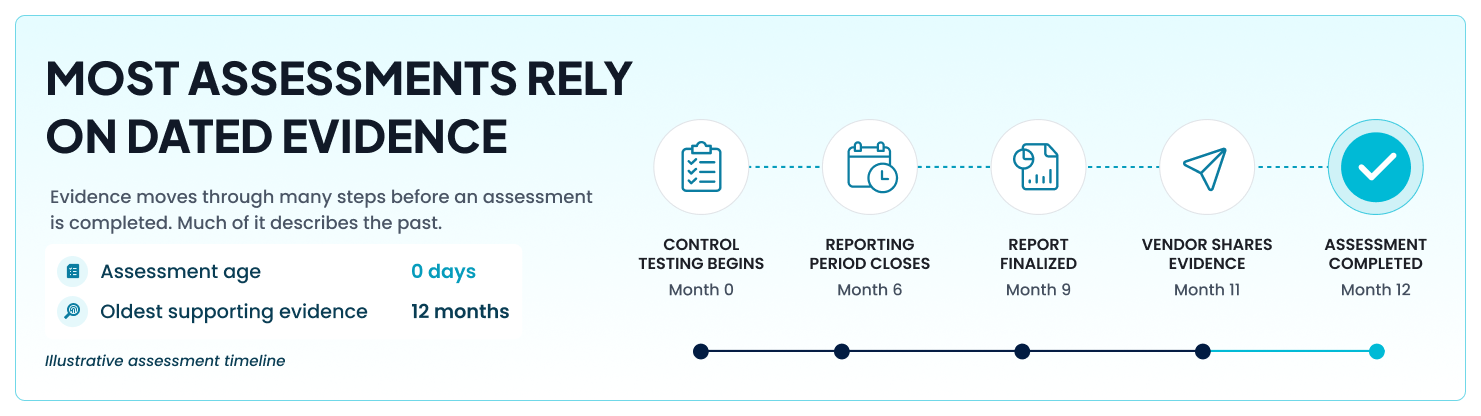
A newly completed assessment is a current decision. It is not necessarily a current picture of the vendor.
A mature program recognizes the age and scope of the evidence instead of letting a recent completion date create false confidence.
The gap after approval, and why it widens
Once the assessment is finalized, the vendor keeps changing. Products ship. AI features are introduced. Subprocessors change. Controls evolve. Infrastructure shifts. Incidents happen.
Some changes are immaterial. Others affect the basis for approval.
Material change is any development that could reasonably affect the basis for approval. That includes changes to scope, data access, criticality, the control environment, or incident posture.
Periodic reassessments are still essential. They create structured opportunities to collect updated evidence, revisit controls, and reconsider decisions.
But calendar-based cycles cannot provide continuous oversight. Material changes do not wait for the next reassessment date.
Monitoring helps reduce blindness between cycles, but it does not complete the response. Alerts do not answer:
- Does this affect the product we use?
- Were our data or users involved?
- Which evidence or assumptions are now outdated?
- Who needs to review and decide?
- What action should follow, and how do we record it?
This is why many programs stall. Monitoring produces more information without a connected path to decision and action.
Where risk work breaks: the handoff tax
Most organizations already have the ingredients: inventories, questionnaires, evidence repositories, assessment workflows, monitoring feeds, ticketing, approvals, and reporting.
The problem is that they often operate independently.
A breach alert appears in one system. The prior assessment sits in another. Evidence is stored in a drive or inbox. Follow-up work becomes tickets and emails. The business owner is notified separately. The decision trail ends up scattered.
That gap is the handoff tax. Every system boundary forces people to reconstruct the context.
In practice, teams have to rebuild the chain manually:
Signal → Vendor → Prior decision → Evidence → Analysis → Action → Record
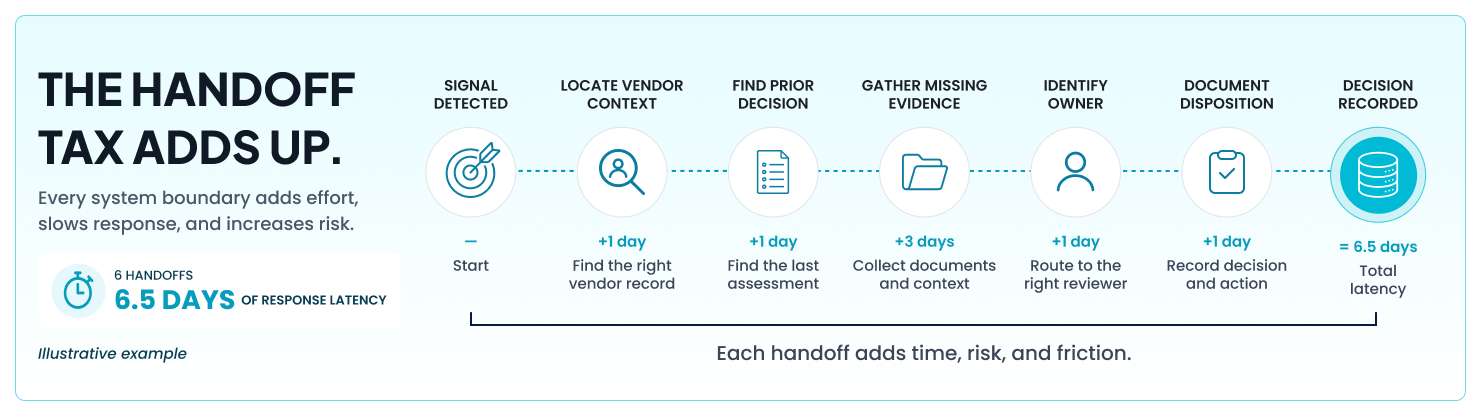
This is one of the hidden costs of continuous TPRM. The burden is not just alert volume. It is the latency created while teams rebuild context and route the work.
What a connected operating model should do
A continuous TPRM operating model should preserve that chain so the program can initiate proportionate follow-up when something meaningful changes.
It should:
- Connect the signal to the correct vendor and service context.
- Pull forward the prior decision, including its assumptions and conditions.
- Identify which evidence may be stale or missing.
- Gather what is needed through public sources or a targeted vendor request.
- Route the review to the accountable owner.
- Record the resulting decision and action.
Not every alert should trigger a reassessment.
The goal is the right work when the facts behind a decision change.
Where agentic TPRM changes the operating model
Traditional automation can schedule questionnaires and reassessments, send reminders, and route approvals. That helps, but it is largely rule-based.
An agentic operating model can coordinate multi-step work based on context.
A material signal can trigger a workflow that pulls forward the prior assessment, identifies what may be outdated, gathers relevant information, prepares a targeted request, summarizes what changed, and routes the case for review.
The system should not silently revoke or renew approval. It should prepare the work required for a qualified person to decide.
Agentic TPRM should not mean autonomous risk acceptance. Risk decisions involve business context, data sensitivity, contractual obligations, operational dependency, compensating controls, and risk tolerance.
Agents assemble the case file. People own the decision.
How Whistic is building toward connected risk operations
Whistic brings assessments, evidence, monitoring signals, issues, approvals, and follow-up work into a shared vendor context.
That foundation helps teams maintain risk decisions between formal review cycles instead of reconstructing the history every time something changes.
Today, Whistic connects monitoring events to actions such as creating an issue or initiating an assessment.
The broader agentic direction is designed to coordinate more of the evidence gathering, analysis, and routing work. The accountable reviewer still makes the final judgment.
This reduces the handoff tax while preserving human ownership of the decision.
FAQs
Why can a recent vendor assessment rely on old evidence?
A SOC 2 report may cover controls tested over six or twelve months and may not be finalized until months after the reporting period ends.
The vendor may share it later, and the assessment process adds more time. A newly completed assessment can therefore rely on evidence describing conditions from several months earlier.
Does every monitoring alert require a new assessment?
No.
Many alerts will be irrelevant, duplicative, already remediated, or adequately addressed by existing controls.
The response should be proportionate. That might mean documenting the event, requesting one piece of evidence, opening an issue, running a targeted review, or revisiting the approval decision.
What is the difference between continuous monitoring and continuous oversight?
Monitoring identifies that something may have changed.
Continuous oversight determines whether it matters, what evidence is needed, who should decide, and what action should follow. It also records the outcome.
What does agentic TPRM change?
Agents can coordinate the handoff work, including gathering evidence, comparing information, summarizing what changed, and routing the case.
People still interpret the context and own the decision.
The assessment is the beginning of an ongoing decision
The next generation of TPRM will not be defined only by how quickly teams complete assessments.
It will be defined by how effectively they maintain the decisions those assessments produce.
You assess a vendor today using the best evidence available. Some of that evidence may already be months old, and tomorrow the vendor will keep changing.
The process has to keep up with the vendor.
Automate the work. Own the decision.