Most security and compliance teams can produce evidence.
That is not the same as being able to rely on it.
The issue is not whether a screenshot, export, ticket, approval, report, questionnaire, certificate, or policy exists. The issue is whether that artifact is attached to a record strong enough to show what was tested, what period was covered, who reviewed it, what exceptions were found, how they were handled, and what decision was made.
That distinction matters because the purpose of evidence is not simply to satisfy a request list. It is to support reliance.
Can management rely on the control? Can audit test it? Can a customer trust the representation? Can a risk owner accept the residual risk based on what was reviewed?
Those are different questions than “do we have the file?”
For years, experienced practitioners have managed that difference manually. They knew where the real records lived. They knew which spreadsheet reflected the current status. They knew which control owner had the missing context. They knew which exception had already been accepted and which piece of evidence needed explanation.
The model was imperfect, but it was workable because the environment still had slack.
That slack is disappearing.
The pressure is increasing in areas where after-the-fact evidence reconstruction is weakest. Gartner has identified cybersecurity vulnerabilities, data governance, and regulatory compliance among the most common risks expected in 2026 internal audit plans, and found that only about half of chief audit executives are highly confident in audit’s ability to provide assurance over cybersecurity vulnerabilities and data governance. KPMG’s 2026 TPRM research points to regulatory compliance and cyber risk as primary drivers of third-party risk strategy, while also noting that true integration and effectiveness remain difficult for most organizations. AI is adding another proof challenge: Grant Thornton found that 78% of executives lack strong confidence that their organization could pass an independent AI governance audit within 90 days.
These are not artifact-storage problems.
They are record problems.
More stakeholders are asking whether the organization can show what happened, who reviewed it, what changed, and why the decision was reasonable.
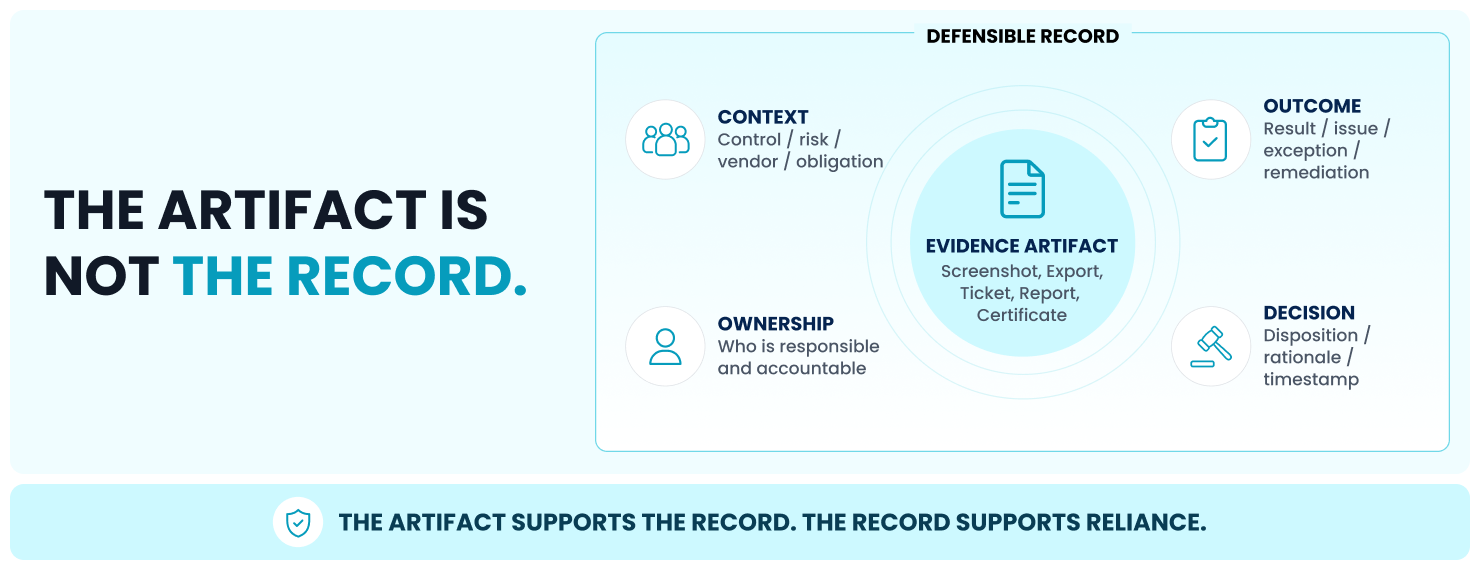
Evidence is necessary. The record makes it usable.
No serious practitioner would argue that evidence does not matter. Auditors, customers, regulators, executives, and internal assurance teams will continue to ask for screenshots, exports, tickets, logs, reports, approvals, policies, completed assessments, and vendor documentation.
The artifact is still necessary. It is just not sufficient.
An artifact can show a point in time. It can demonstrate that a configuration existed, a workflow ran, a review occurred, or an approval was granted. But standing alone, it rarely answers the broader assurance question.
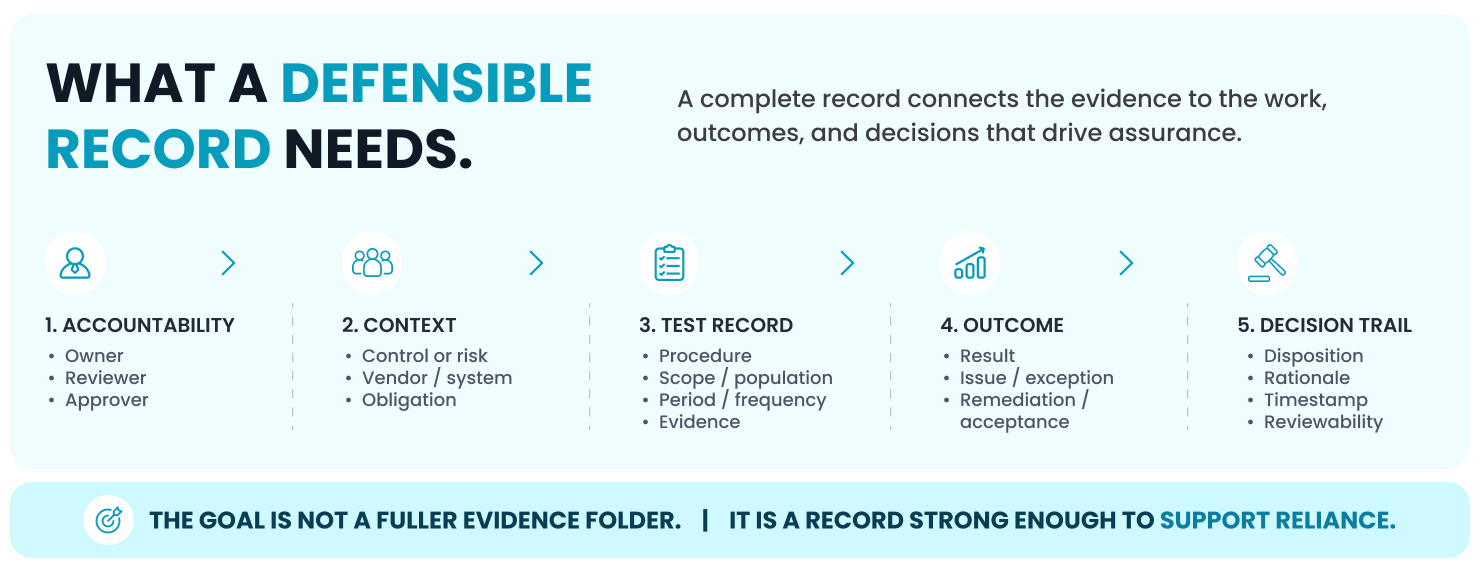
A defensible record should capture five things:
- Accountability: owner, reviewer, approver.
- Control or risk context: obligation, requirement, vendor, system, business process, or risk decision.
- Test or review record: procedure, scope, population, period, evidence.
- Outcome: result, issue, exception, remediation, or acceptance.
- Decision trail: disposition, rationale, timestamp, reviewability.
When those elements are missing, the artifact becomes dependent on memory. Someone has to explain what it means. Someone has to confirm whether it was current. Someone has to map it back to the control, vendor, issue, or obligation. Someone has to reconstruct why the result was accepted.
That is where evidence collection becomes expensive. Not at the moment of upload, but later, when the organization has to make the artifact meaningful again.
The record should also be proportional. A key control tied to a material risk, customer commitment, regulatory obligation, or significant third-party dependency needs more depth than a low-risk administrative control.
The point is not to over-document everything.
The point is to make the record strong enough for the reliance being placed on it.
Proof latency shows where the model is breaking
Proof latency is the delay between when risk or compliance work happens and when the organization has a complete, reviewable record of that work.
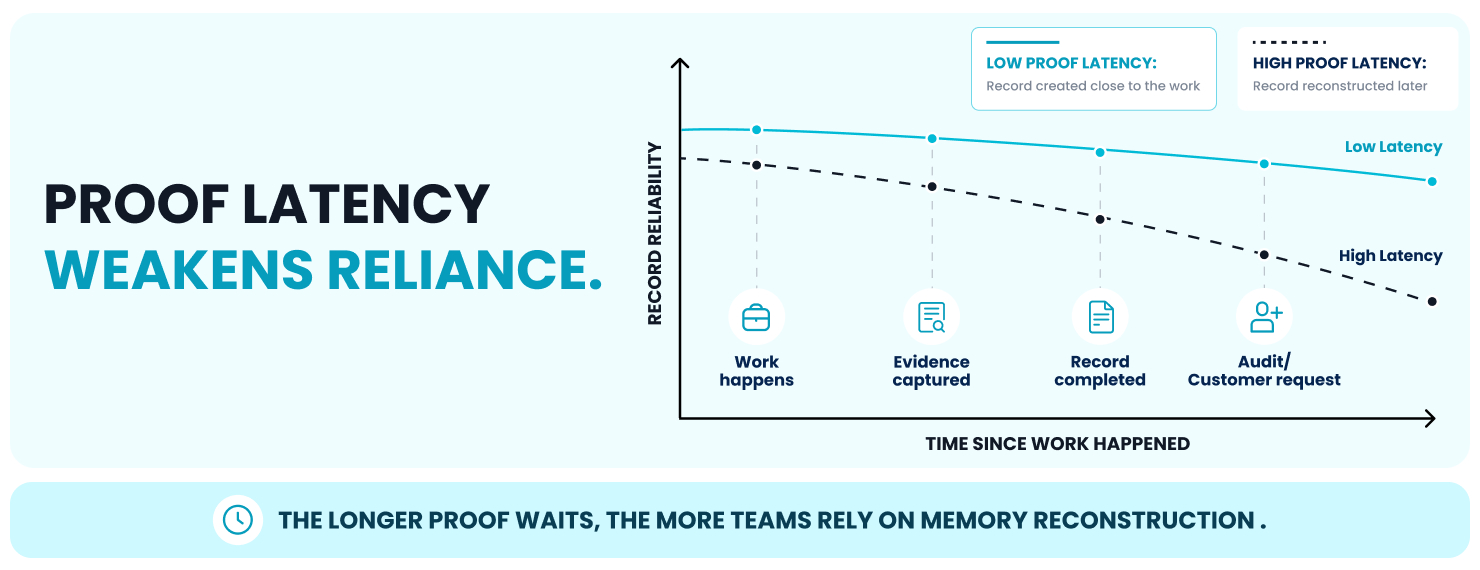
When proof latency is low, context is captured while it is fresh. Evidence, timestamp, result, exception, issue, and decision stay close to the work.
When proof latency is high, the team pays reconstruction debt later. Owners are chased. Screenshots are refreshed. Tickets are exported. Reviewer comments are clarified. Decisions are restated for people who were not there when the work happened.
That is not a failure of effort. It is a sign that proof was created too late.
Consider control testing. A team may define a control, run a test, capture evidence, identify an exception, and decide whether to remediate, accept, or retest. If the evidence is saved in one place, the test result in another, the exception in a spreadsheet, and the decision in email, the control work happened, but the record is fragile.
A stronger model keeps the control, test, evidence, timestamp, result, exception, remediation status, and decision connected as the work happens. The practical question is not only, “Do we have evidence?” It is, “Can someone understand the outcome without rebuilding the record from three systems and two conversations?”
The same pattern appears in vendor assessments. A vendor provides a SOC 2 report, ISO certificate, questionnaire, penetration test summary, or policy set. The risk team reviews the evidence, maps it to requirements, identifies gaps, opens issues, accepts residual risk, or approves the vendor with conditions.
At the time, the decision may be sound. But if the evidence, issues, business context, residual risk decision, and approval rationale separate after the review, the next assessment starts by recreating judgment that already happened.
Reusable vendor evidence only matters when it remains connected to the decision it supported. Otherwise, the team has artifacts, but still has to rebuild the reasoning.
Access reviews show the same operating issue in a different workflow. The review may happen in an identity platform, the population may come from HR or IAM, exceptions may be discussed in email, remediation may happen through tickets, and final sign-off may be captured somewhere else.
By the time audit asks for proof, the evidence exists, but it is distributed. The team has to show that the population was complete, reviewers were appropriate, access was evaluated, exceptions were handled, remediation occurred where required, and final approval happened within the required period.
The review happened. The issue is that the record did not stay intact while it happened.
The correction is operational
Moving from evidence collection to stronger records is not a matter of rhetoric. It requires operating decisions.
Ownership, evidence standards, review procedures, exception handling, issue management, and decision retention need to be defined before the audit request arrives. The hard part is not naming those elements. Practitioners already know them. The hard part is keeping them connected while work moves across assessment workflows, vendor portals, control tests, monitoring signals, ticketing systems, cloud consoles, spreadsheets, chat threads, and email.
None of this eliminates the need for judgment. In many risk and compliance workflows, judgment is the point. Management review, risk acceptance, vendor approval, compensating control evaluation, exception disposition, and no-action decisions all require experienced humans.
The objective is not to automate judgment out of the program.
The objective is to keep the record of judgment attached to the work.
Technology cannot fix weak control design, unclear ownership, or poor governance. A bad process digitized is still a bad process.
But when the operating model is clear, technology can reduce proof latency. It can help capture evidence closer to the point of work. It can preserve timestamps. It can connect evidence to controls, tests, vendors, issues, exceptions, monitoring signals, and decisions. It can reduce the rework required to explain what already happened. It can make the record reviewable without relying on institutional memory.
That is the role platforms should play. Not just storing artifacts. Carrying the record forward as the work happens.
Where to start
For teams trying to improve, the best starting point is usually not a full program redesign. It is the set of controls, vendor reviews, or assurance processes that already create disproportionate effort.
Look for the places where proof latency is already visible.
Where do reviewers ask the same follow-up questions every cycle? Which controls require the same screenshot refreshes? Which vendor reviews restart from evidence that was already collected? Which exceptions are understood by the team but hard to prove later? Which decisions live outside the system of record? Where does audit, renewal, or reassessment work restart from scratch?
Those questions usually reveal where the model is working and where it is relying on operational glue.
The evidence model was useful for a long time. It gave teams a way to organize requests, support audits, and create structure around compliance activity. It should not be dismissed.
But the pressure has changed.
The old model can still collect artifacts. What it struggles to do is preserve the context needed to rely on them.
That is the necessary correction.
Artifacts should still be collected, but they should not be asked to carry the assurance story alone.
The record has to carry that story.
Ownership. Test design. Evidence. Timestamp. Result. Issue. Exception. Disposition. Decision.
When those elements stay connected, audit readiness becomes less dependent on reconstruction. Vendor reviews become less dependent on rediscovery. Compliance evidence becomes easier to rely on because the context is already there.
The goal is not a fuller evidence folder. The goal is a record strong enough to support reliance.