The scarce resource becomes accountable attention
It is tempting to describe this future simply as a shift from human execution to human judgment. That is directionally right, but incomplete.
AI will become better at forms of reasoning we currently consider judgment. It will get better at comparing contradictory evidence, recognizing unusual conditions, incorporating business context, and recommending an action.
The more durable scarce resource is accountable attention.
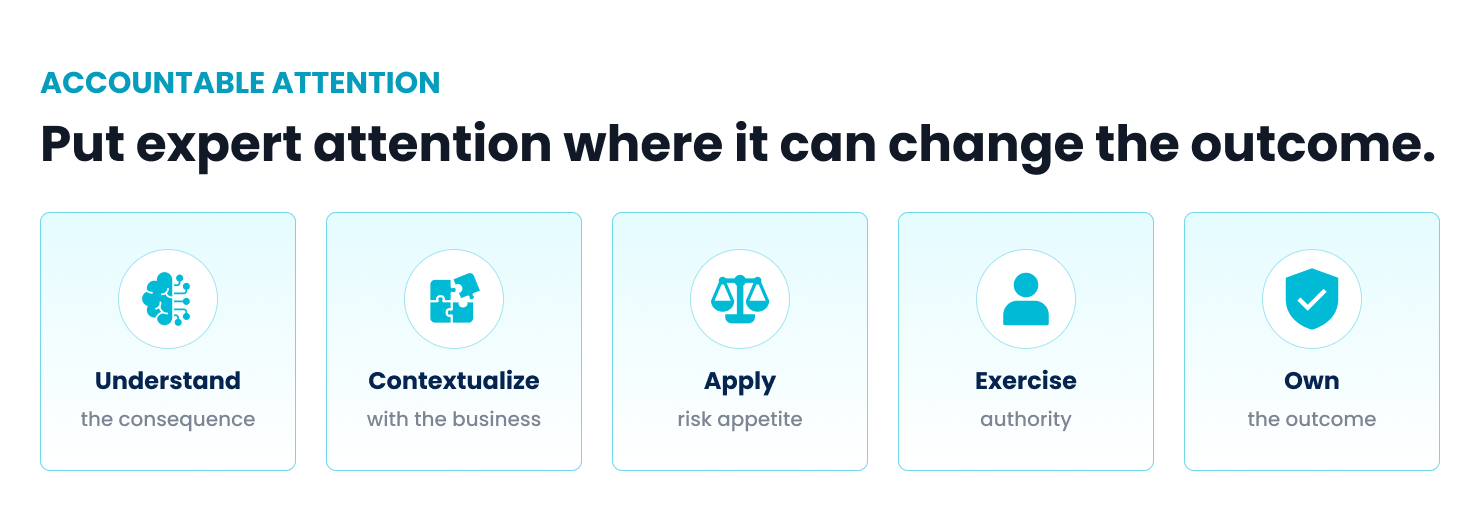 Most expert risk time is consumed operating the process, not deciding the outcomes that require authority.
Organizations have a limited amount of expert attention they can apply to decisions that matter. Someone has to understand the consequence of the exception. Someone has to involve the business when its context changes the answer. Someone has to determine whether the exposure fits the organization's risk appetite. Someone has to exercise the authority to approve, reject, mitigate, or accept the risk.
And someone ultimately owns the consequence of that decision.
That kind of attention is expensive for good reason.
The strategic promise of agentic TPRM is not to make it cheap. It is to stop spending so much of it on work that never required it.
This also changes what AI maturity should mean for a TPRM program. Assessment volume is useful. Automation rate is useful. Hours saved are useful. Human touchpoints eliminated are useful. But they are intermediate measures.
Executives should ultimately care about questions such as:
- Can we cover more of the relevant third-party population without lowering our assurance standards?
- Can material changes trigger proportionate diligence sooner?
- Can high-risk vendors receive deeper attention without equivalent growth in administrative workload?
- Are evidence standards being applied more consistently?
- Do consequential exceptions reach the right authority faster?
- Is more expert attention reaching the decisions where it can actually change the outcome?
- And does all of this improve confidence in the decisions the organization makes?
Those are measures of the operating model, not the technology.
They also reveal why data quality, evidence standards, decision rights, and escalation criteria become more important as automation grows.
KPMG found that only 17% of organizations reported the highest level of TPRM data quality, while higher-quality data was associated with greater confidence in risk decisions.
When a person is doing the work, bad data creates friction. When software is acting on the work, bad data can shape execution.
The same is true of unclear policies, inconsistent evidence expectations, and ambiguous authority.
Agentic AI can scale a well-designed operating model. It can also scale an incoherent one.