For years, that distinction was easy to overlook because the assessment consumed most of the work. People scoped the review, requested documents, chased responses, read reports, mapped evidence, scored controls, documented findings, prepared a summary, and routed it for approval.
So the industry sensibly optimized the assessment: shorter questionnaires, reusable evidence, automated reminders, external signals, and AI analysis.
All of it helped. But it also made “assessment complete” feel like a proxy for “risk managed.”
Assessment complete is an operational status, not a risk outcome.
An assessment creates understanding. It can reveal an exposure, reduce uncertainty, or show that a vendor meets expectations. But it does not determine what the organization will do.
A decision does.
Approve the vendor. Reject it. Require remediation. Restrict the use case. Add a compensating control. Accept the residual risk. Escalate the issue.
A risk practitioner could fairly object that a decision alone does not patch a vulnerability or change a control. The action that follows does. But the decision is where assessment information becomes risk governance.
Until then, the assessment is evidence waiting for an owner.
NIST’s 2026 supply-chain due-diligence guidance similarly frames due diligence as research used to support informed decisions.
The assessment sits in the middle of the operation
A useful way to see the full job of third-party risk management is:
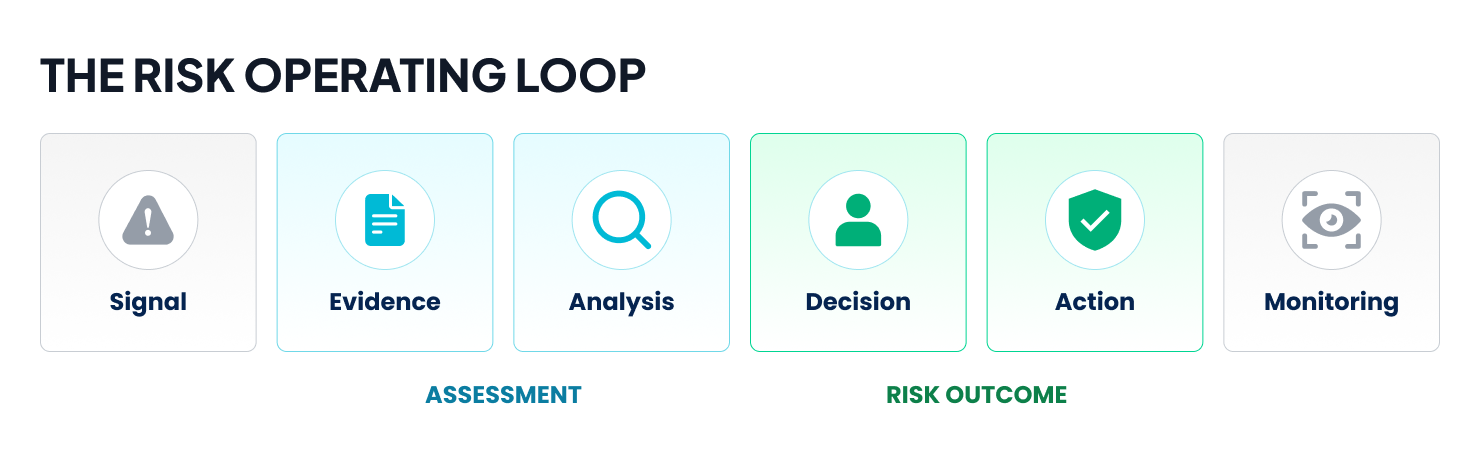
A new vendor request is a signal. So is a breach alert, an expired certification, a product change, a new subprocessor, or a shift in how the business uses the vendor.
- Evidence establishes what is known.
- Analysis determines what it may mean.
- A decision applies business context, risk appetite, and authority.
- Action changes the relationship, control environment, or formal treatment of the risk.
- Monitoring tests whether the assumptions behind the decision still hold.
The assessment generally occupies the evidence and analysis portions of that chain. Those stages are essential. They are not the whole operation.
A report produced in 30 minutes that waits two weeks for action is not a fast risk process.
The better optimization target is decision velocity